
Best Outdoor Rabbit Hutch: Safe, Spacious Picks for 1–4 Rabbits

The best outdoor rabbit hutch gives your rabbit a dry sleeping area, safe airflow, easy cleaning access, and enough room for daily movement. Size matters, but it is not the only thing to check.
You also need to think about tray design, weather protection, predator security, and whether your rabbit needs a separate run or playpen. This guide shows you how to compare hutch types and choose the right Aivituvin setup for your home.
What Really Makes a Good Outdoor Rabbit Hutch?
A good outdoor rabbit hutch should stay dry, clean easily, protect your rabbit from weather, and give them a secure place to rest. Size is important, but daily care features matter just as much.

Hygiene and Waste Management
Rabbit hutches get dirty quickly if the tray is shallow or hard to remove. Urine can soak into wood, bedding can stay damp, and odor builds up faster when airflow is poor.
Tray design is one of the easiest details to compare before you buy. For example, Aivituvin AIR10 uses 1.8-inch deep trays, which are 0.4 inches deeper than the standard listed on its product page. The removable wire mesh and sliding tray also make cleanup easier because you can pull out waste without taking the whole hutch apart.
For everyday care, look for:
-
Deep Pull-Out Trays: Help reduce leakage and keep waste away from the wood frame.
-
Removable Wire Mesh: Makes weekly cleaning easier and keeps the tray area more accessible.
-
Multiple Access Doors: Help with feeding, handling, and quick spot cleaning.
-
Easy-Safe Bedding: Paper-based bedding is usually easier on airways than dusty wood shavings.
A deeper tray does not remove the need for regular cleaning, but it makes the job less messy.
Space and Natural Behavior
Rabbits need more than a small sleeping box. They need room to stretch, turn, stand, hide, and move around comfortably.
That means a hutch should usually work as a protected home base, not the rabbit’s only movement area all day. For outdoor setups, a hutch with a run or a separate playpen can make the living space much more practical.
Weather Protection
An outdoor rabbit hutch needs shade, ventilation, and a dry sleeping area. Heat is especially important because rabbits handle hot weather poorly.
The MSD Veterinary Manual notes that prolonged exposure above 80°F may make rabbits sick, especially in poorly ventilated hutches. That is why you should avoid placing a hutch in full sun all day.
Look for these weather-ready details:
-
Raised Legs: Help keep the base away from wet ground.
-
Solid Roof Coverage: Keeps rain off the sleeping area and adds shade.
-
Ventilated Mesh Panels: Allow airflow without leaving the hutch fully exposed.
-
Non-Toxic Coating: Protects the wood while staying safer for rabbits that chew.
Predator-Resistant Security
A rabbit hutch should make your rabbit feel hidden, protected, and hard to reach from the outside. This matters even in suburban yards.
Useful security features include:
-
Strong Door Latches: Harder for raccoons or other animals to work open.
-
Galvanized Mesh Panels: Better than thin, loose chicken wire for long-term outdoor use.
-
Solid Wood Framing: Adds structure and keeps the hutch from feeling flimsy.
-
Raised Sleeping Area: Helps separate the rabbit’s resting space from ground-level moisture and pests.
No outdoor hutch is completely risk-free, so placement still matters. Keep it in a visible, sheltered area and check locks, mesh, and wood joints regularly.
What's the Difference Between Single-Story, Double-Story, and a Hutch with Run?
The best hutch type depends on your rabbit count, yard space, cleaning routine, and how you plan to give your rabbit daily movement.

Single-Story Hutches
A single-story hutch keeps everything on one level. That makes it easier for older rabbits, smaller rabbits, or rabbits that do not like ramps.
This setup is also simple to clean. You usually deal with one tray, one main floor, and fewer tight corners. The trade-off is space. A single-story hutch needs more ground area if you want the same usable room as a two-level model.
Choose this type when:
-
You have 1–2 rabbits.
-
You want the simplest cleaning routine.
-
Your rabbit is older or less confident with ramps.
-
You have enough patio or yard space for a wider footprint.
Double-Story Hutches
A double-story hutch gives you more usable area without taking up as much ground space. The upper level can work as a quieter resting zone, while the lower level gives your rabbit another place to move, eat, or explore.
This design is useful for paired rabbits or small multi-rabbit households, but ramps are not ideal for every rabbit. Watch how your rabbit moves before assuming a two-level layout is always better.
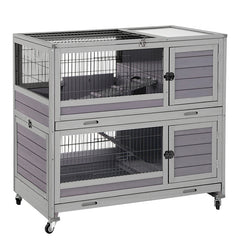
Aivituvin AIR18 and AIR34 are good examples of this style. They share the same design, with the main difference being color, and both can be separated into two individual stories. That flexibility is useful when you need temporary separation or want a setup that can change later.
Hutch with Run or Playpen Setup
A hutch with a run gives your rabbit a sheltered resting area plus extra movement space. This is usually more practical than expecting a compact hutch to do everything.
You can choose a built-in hutch-and-run model, or you can pair a standard hutch with a separate exercise pen. For many families, the second option is easier to adjust because you can move the pen, expand it, or bring it indoors when needed.
This setup works best when:
-
Your rabbit is active and needs more daily movement.
-
You want a more flexible indoor/outdoor routine.
-
Your yard has enough safe, shaded space.
-
You can supervise outdoor playtime when needed.
Which Aivituvin Rabbit Hutch Should You Get?
Once you know your space and cleaning routine, the next step is matching the outdoor rabbit hutch style to your rabbit’s daily needs. AIR10 is the simple single-story choice, AIR18/AIR34 gives you more two-level space, and AIR06-C works better when you want a compact mobile hutch for indoor or sheltered outdoor use.
|
Your Situation |
Best Pick |
Space / Setup |
Why It Fits |
|
1–2 rabbits, simple daily cleaning |
AIR10 |
8.3 ft² |
Single-level layout, deep trays, removable wire mesh, and wheels |
|
2–3 rabbits, larger double-story setup |
AIR18 / AIR34 |
14.1 ft² |
More usable space, two stories, and separable levels |
|
Compact indoor/outdoor placement |
AIR06-C |
8.32 ft² |
Two-story design, wheels, deep trays, lockable front doors, and a small footprint |
|
Rabbits that need more exercise space |
Hutch + playpen setup |
Depends on layout |
Better for daily movement than relying on a compact hutch alone |
Prices, stock status, and color options can change, so check the product or collection page for the latest details before buying.
AIR10 — Best for Simple Cleaning and Easy Movement
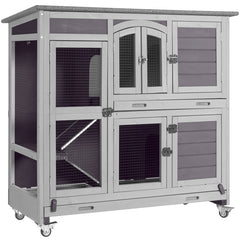
AIR10 Rabbit Hutch is a strong choice when you want a practical single-level hutch that is easy to clean, move, and manage every day.
The product has 8.3 ft² of inner space and an overall size of 40.6"L × 26" W × 34.4" without wheels, or 37"H with wheels. It is suitable for 2–3 rabbits or small pets, but it is more comfortable for 1–2 rabbits when used as a main hutch.

Useful features include:
-
Deep Pull-Out Trays: 1.8" trays help reduce leaks and make waste cleanup easier.
-
Removable Wire Mesh: Lets you separate the tray area for faster cleaning.
-
Multiple Access Points: Front doors, side doors, and a roof hinge help with feeding and handling.
-
PVC Curtain and Small Ramp: Create a more protected inner area for resting.
-
Wheels: Make it easier to reposition the hutch for cleaning, shade, or indoor/outdoor use.
AIR10 is best for owners who want a low-maintenance hutch with a simple one-level layout.
AIR18 / AIR34 — Best Double-Story Pick for Paired Rabbits
AIR18 /AIR34 Rabbit Hutch use the same two-level design. AIR18 is the grey option, while AIR34 is the brown option.
The main advantage is layout. The 14.1 ft² design gives rabbits an upper and lower level, so you get more usable space without taking up as much ground area as a wider single-story hutch. Aivituvin also lists AIR18 and AIR34 as models that can be separated into two individual stories, which adds flexibility when you need to adjust the setup.

Key features include:
-
14.1 ft² Inner Space: Gives paired rabbits more room than a compact single-level hutch.
-
Two-Level Layout: Separates resting and activity areas.
-
Dual Deep Pull-Out Trays: Helps make cleaning each level more manageable.
-
Lockable Wheels: Makes the hutch easier to move and keep stable when parked.
-
UV-Proof Roof: Adds shade and rain protection for outdoor use.
-
Bonus Feeder and Chew Toy: Adds basic enrichment right out of the box.
For paired rabbits or a small multi-rabbit home, AIR18/AIR34 is the stronger pick than a compact single-story hutch. Explore the full range of large rabbit hutch options to compare sizes and configurations for multi-rabbit households.
AIR06-C — Best Compact Two-Story Hutch for Flexible Placement
The AIR06-C 2-Story Rabbit Hutch is the better choice when you want a compact hutch that can move between indoor, patio, and sheltered outdoor areas. It does not replace a full exercise run, but it gives rabbits a two-level home base with easier cleaning and flexible placement.

AIR06-C works well for smaller homes because of these features:
-
Two-Story Layout: The stairs and platforms give rabbits separate upper and lower areas for resting, moving, and exploring.
-
8.32 ft² Listed Space: The hutch offers a compact footprint while still giving more structure than a basic single-box cage.
-
Four Wheels with Two Brakes: You can move the hutch for cleaning, shade, storage, or indoor/outdoor placement, then lock it in place.
-
Two Deep Plastic Trays: The removable trays help contain mess and make routine cleaning easier.
-
Four Lockable Front Doors: The front access points make feeding, checking, and handling less awkward.
-
Waterproof Roof: The roof helps protect the hutch during outdoor use, especially in covered or semi-sheltered areas.
AIR06-C is best for owners who want a mobile, compact, two-story rabbit hutch rather than a full hutch-and-run system. If your rabbit needs more daily movement, pair it with supervised floor time or a separate play area. Check the outdoor rabbit hutch collection for current availability and full specs.
How Do You Set Up and Care for an Outdoor Rabbit Hutch?
A good setup keeps the hutch shaded, dry, secure, and easy for you to clean every week. Placement matters just as much as the model you buy.

Choosing the Right Location in Your Yard
Place the hutch where it gets morning sun and afternoon shade. Full-day direct sun is risky for rabbits, especially during hot or humid weather.
A good location should have:
-
Afternoon Shade: A fence, wall, tree, or covered patio can help reduce heat exposure.
-
Good Drainage: Avoid low spots where water collects after rain.
-
Wind Protection: Keep the back or side of the hutch away from strong prevailing winds.
-
Easy Visibility: Put the hutch where you can check your rabbit often.
-
Digging Control: If the hutch sits on grass, check the edge regularly for digging.
A shaded, well-drained area usually works better than the sunniest part of the yard.
Seasonal Care
Summer care is mostly about shade, airflow, and water.
-
Add shade cloth during hot periods.
-
Refill water more often on warm days.
-
Keep the hutch out of direct afternoon sun.
-
Move the hutch to a cooler sheltered area when needed.
-
Avoid leaving rabbits in an open run during the hottest part of the day.
Winter care is mostly about wind, dampness, and bedding.
-
Add dry hay or safe bedding for warmth.
-
Block direct wind while keeping ventilation open.
-
Keep the hutch floor and tray dry.
-
Check the roof and wood coating before rainy weeks.
-
Inspect latches, mesh, and fasteners after storms or freezes.
Year-round, test door latches and check mesh panels every few weeks. Small damage is easier to fix before it becomes a safety problem.
Helping Your Rabbit Settle Into a New Hutch
Give your rabbit time to explore the new hutch slowly. A familiar smell helps.
Place a little old bedding, a favorite toy, or a familiar hide inside the hutch before the first use. Keep the area quiet for the first few days, and let your rabbit enter on their own when possible. Treats can help, but avoid forcing the transition.
Some rabbits settle in within a few days. More cautious rabbits may need longer, and that is normal.
Common Questions About Outdoor Rabbit Hutches
Can I use an outdoor rabbit hutch indoors too?
Yes, many Aivituvin hutches can work indoors or outdoors, depending on the model and placement. Wheels make indoor repositioning easier, but you still need airflow, dry bedding, and regular tray cleaning to control odor.
What is the difference between AIR18 and AIR34?
AIR18 and AIR34 use the same two-level design. The main difference is color: AIR18 is grey, and AIR34 is brown. Both can be separated into two individual stories, so choose based on the look you prefer and current availability.
Do I need a separate run if I already have a hutch?
Yes, you still need a movement plan unless the setup already gives your rabbit enough safe exercise space. A compact hutch such as AIR06-C works well as a home base, but it should not be treated as a full run.
For many homes, a pet playpen paired with a standard hutch is a practical and flexible solution. It gives your rabbit more room to move while keeping the main hutch easier to clean and place.
How do I stop my rabbit hutch from smelling?
Odor usually comes from urine, damp bedding, and poor airflow. Empty the tray often, use low-dust bedding, keep mesh panels clear, and clean the tray with a rabbit-safe cleaner. A deeper pull-out tray, like the 1.8-inch tray on AIR10, also helps reduce mess around the wood frame.
Ready to Find the Right Hutch for Your Rabbit?
The best outdoor rabbit hutch should make daily care easier while giving your rabbit a cleaner, safer, and more comfortable home base.
Choose AIR10 if you want a simple single-story hutch with easy cleaning access. Choose AIR18/AIR34 if you need more usable space in a two-level layout. Choose AIR06-C if you want a compact mobile hutch that can work indoors, on a patio, or in a sheltered outdoor area.
If your rabbit needs more room to move, plan for supervised exercise time or add a separate playpen instead of expecting the hutch to do everything. The outdoor rabbit hutch collection has size details and current availability to help you compare the right setup.